
Satire
Three Leaders Pledge More Oil, Each by Destroying the Other Two’s Oil
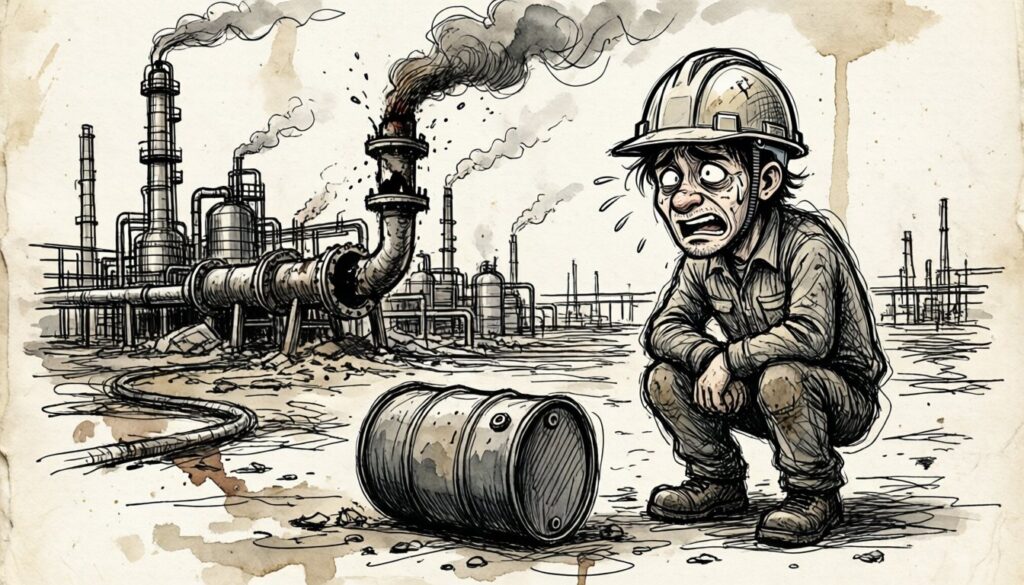
Satire – none of this happened.
GENEVA — The leaders of the United States, Russia and China pledged on Tuesday to increase global petrol supplies, each presenting a detailed plan to achieve it by continuing to destroy the oil infrastructure of the other two.
The three men stood at podiums arranged in a triangle so that no one had to stand beside anyone. Aides described the arrangement as logistical.
Under the agreement, Washington will raise output by maintaining sanctions on Russian crude, Moscow will raise output by striking Ukrainian refineries and Black Sea loading terminals, and Beijing will raise output by buying discounted barrels from both and refining them, a step the joint communiqué refers to throughout as "the increase."
"It's very simple," said a senior official briefed on all three positions, speaking on condition of anonymity because the briefing was also off the record for two governments that did not send anyone. "Every barrel we stop from reaching the market is a barrel that stays in the ground. A barrel in the ground is future supply. We are increasing supply enormously."
Analysts were sceptical. "The mechanism is not obvious," said Dr Halvard Nunn of the Institute for Strategic Arithmetic, a research body that exists. "Historically, when you bomb a refinery, the refinery produces less petrol afterwards. This is one of the more robust findings in the field."
Officials rejected the criticism as "accounting." A background document circulated to reporters explains that the three governments now measure supply in "commitment barrels," a unit defined in Annex C as a barrel that has been pledged, discussed at a summit or mentioned in a headline, and which need not exist at any point in the physical world.
By that measure, Tuesday was the largest single-day increase in the history of oil. The document puts the figure at 400 million commitment barrels a day, a number it describes as conservative.
The leaders did not take questions. Each read a short statement. One called the day "historic," one called it "unprecedented," and one called it "not something I would have done for anyone else," and the three delegations later confirmed that the statements had been drafted jointly and were, in that sense, also a form of cooperation.
Asked repeatedly how the pledge would be implemented, officials pointed to a follow-up summit scheduled for the autumn, at which the three governments are expected to reaffirm the pledge and, if scheduling permits, pledge it again.
"People want to know the how," the senior official said. "The how is that we have said it. That is what a pledge is. If we had wanted to do something, we would have called it a policy."
Markets were unmoved. Brent crude closed marginally higher, which officials cited as proof the plan was working and analysts cited as proof that markets had not read the plan.
At the close of the conference the three leaders walked off in three directions, each toward a motorcade, none toward a refinery.
—
Satire. This piece is invented. What actually happened: Trump, Putin, Xi pledge to increase global petrol supplies – but how? (aljazeera.com).
This article was drafted with AI assistance and checked before publication.